
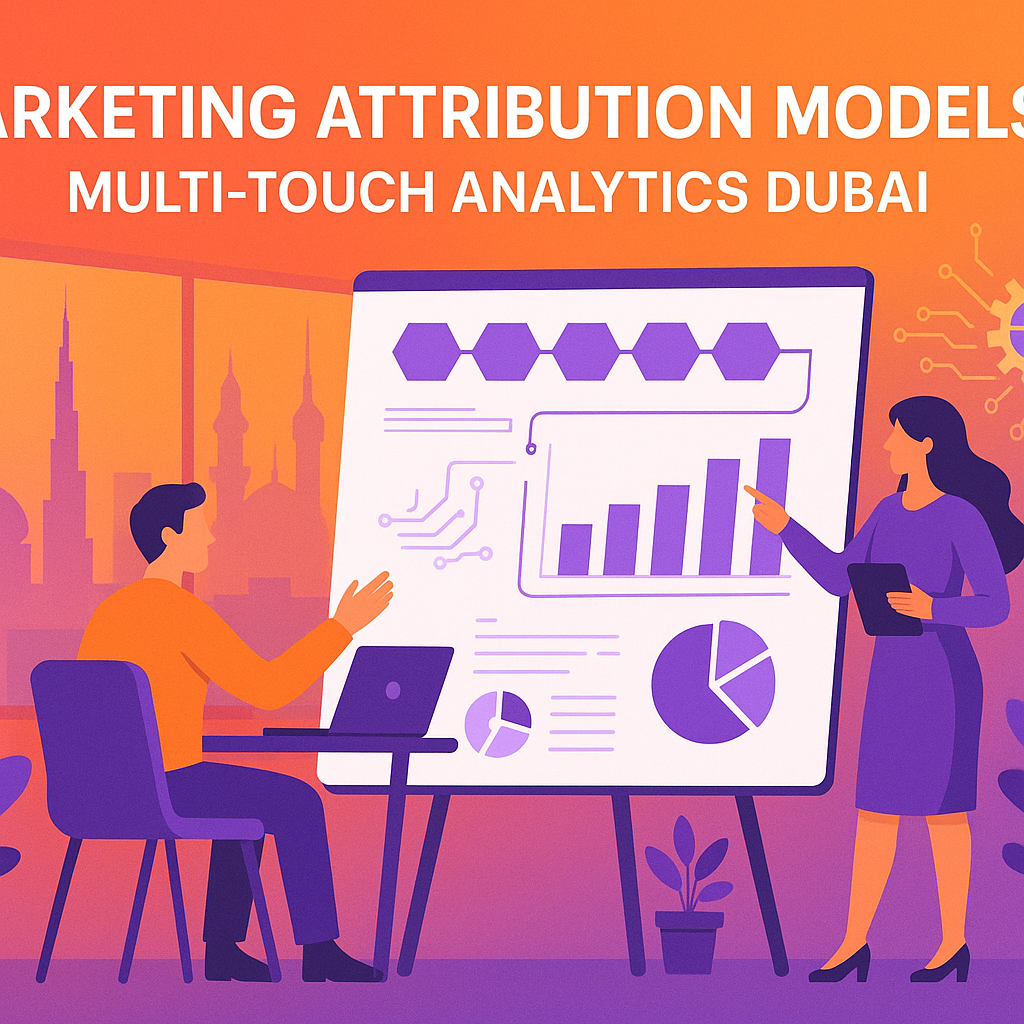
Marketing Attribution Models: Multi-Touch Analytics Dubai
Advanced guide to multi-touch marketing attribution for Dubai campaigns — strategy, AI-driven models, implementation roadmap, UAE examples (Emaar, Careem, Noon) and a CPD-certified course.
🎯 Quick Answer
Multi-touch attribution (MTA) assigns credit across all touchpoints in a customer journey to reveal which channels drive conversions. For digital marketing Dubai campaigns, pair server-side tracking, GA4, CRM integration and AI-driven algorithmic models to improve ROI, reduce wasted ad spend and support data-driven decisions.
Key Insight: Multi-touch analytics turns fragmented Dubai campaign data into a clear ranking of high-value channels and creative.
Why marketing attribution matters for Dubai teams
Strategic value for marketers
Attribution answers the question: which marketing activity produced the conversion? In fast-moving UAE markets, precision matters for budget allocation, especially during peak seasons like Expo-driven tourism spikes.
Business outcomes
Right attribution improves ROI, reduces CPA, and informs creative and channel decisions. Organizations such as Emaar and Dubai Tourism increasingly rely on multi-touch insights to optimise campaigns across web, app, programmatic and offline activations.
Key Insight: Attribution is not only measurement — it’s a decision layer that powers automated bidding and creative personalization.
Common attribution models: strengths and weaknesses
Last-touch and first-touch (simple, biased)
Last-touch assigns all credit to the final interaction; first-touch assigns to the first. These are easy to implement but often misattribute value in long Dubai purchase journeys where multiple micro-conversions occur.
Linear and time-decay (fairer credit allocation)
Linear splits credit evenly across touchpoints. Time-decay weights recent interactions more. Both improve fairness but still miss interaction context and diminishing returns patterns.
Position-based and algorithmic models
Position-based (e.g., 40-20-40) gives more credit to first/last. Algorithmic uses statistical or ML models to learn contribution from historical data. Algorithmic models are best for complex Dubai ecosystems with app + web + offline touchpoints.
Key Insight: For enterprise Dubai campaigns (Emaar, Noon), algorithmic attribution reduces misattribution from cross-device journeys.
Building a multi-touch analytics stack for UAE campaigns
Core data sources
- Digital: GA4, server logs, ad platforms (Google Ads, Meta, TikTok).
- App: SDK events, deep-linking, in-app purchases (Careem app telemetry).
- CRM & CDP: lead status, offline bookings, call center data (Emaar, Dubai Tourism).
Technical components
- Tag management (GTM or server-side GTM).
- Server-side event tracking to reduce browser loss.
- Deterministic + probabilistic identity stitching (email, user IDs, device IDs).
- Data warehouse (BigQuery, Snowflake) as the single source of truth.
Pro Tip: Start with a lightweight data layer. Standardise event names in English and Arabic for cross-team clarity in Dubai teams.
AI-driven algorithmic attribution: models and use cases
Types of algorithmic models
- First-principles statistical: logistic regression, SHAP explainability.
- Time-series & uplift models: capture seasonality and incremental effects.
- Deep learning: sequence models for long, cross-device journeys.
Applying AI marketing UAE
AI automates feature engineering (recency, frequency, device transitions), imputes missing data, and outputs channel contribution scores. Careem used ML to optimise app acquisition channels by weighting onboarding touchpoints differently for high-LTV riders.
Key Insight: Use explainable AI (XAI) to validate model decisions — essential for stakeholders in Dubai’s cross-functional teams.
Measuring true impact: incrementality and LTV
Incrementality testing
Holdout tests and geo experiments measure the lift from media spend. For Dubai Tourism, running controlled lift studies during off-peak months reveals true campaign impact beyond correlated lifts from seasonal demand.
Customer Lifetime Value (LTV) integration
Attribution should weight conversions by expected LTV, not just first purchase. Noon and Emaar use LTV-forward attribution to prioritise channels that bring repeat customers and higher-margin buyers.
Important: Attribution that ignores incremental lift will overvalue channels that correlate with conversions but do not cause them.
Implementation roadmap for Dubai campaigns
Phase 1 — Foundation (Weeks 0–4)
- Audit current tracking across web, app and offline sources.
- Implement or clean a standard data layer.
- Set KPIs aligned to business outcomes (revenue, leads, LTV).
Phase 2 — Build & Integrate (Weeks 4–8)
- Deploy server-side tracking and identity stitching.
- Integrate ad platforms and CRM into the data warehouse.
- Start exploratory algorithmic models and baseline comparisons.
Phase 3 — Test & Scale (Weeks 8–12)
- Run holdout/incrementality tests and validate model outputs.
- Feed attribution outputs to automated bidding and creative templates.
- Set governance: model refresh cadence, QA checks, stakeholder dashboards.
Key Insight: A 12-week sprint can produce a production-ready multi-touch attribution system suitable for Dubai midsize enterprises.
Case studies & comparison: Emaar, Dubai Tourism, Careem, Noon
Emaar: omnichannel real estate journeys
Emaar tracks web form fills, virtual tours, call bookings and showroom visits. Position-based and algorithmic attribution combined helped them re-weight media spend toward digital tours and influencer content that drove qualified appointments.
Dubai Tourism: seasonality and incrementality
Dubai Tourism runs geo lift tests during shoulder seasons to isolate campaign effect from macro trends. Multi-touch analytics linked digital creative variants to specific booking windows.
Careem: app-first conversions
Careem’s mobile-first journey required deterministic identity stitching. MTA highlighted onboarding incentives and in-app messaging as key conversion drivers for rider retention.
Noon: marketplace seller acquisition
Noon integrated seller onboarding events with marketplace LTV to prioritise channels that bring high-quality sellers, not just volume.
| Feature | Position-Based | Algorithmic |
|---|---|---|
| Required data | Basic touchpoint logs | Historical multi-source data + modelling |
| Accuracy | Medium | High |
| Scalability | High (easy) | High but needs infra |
| Best for | Small to mid campaigns | Enterprise, cross-device UAE markets |
Key Insight: Start with a hybrid approach: use rule-based models for speed and algorithmic for validation and scale.
Careers & training: becoming an attribution specialist in Dubai
In-demand skills
- Analytics: SQL, BigQuery, Python/R for modelling.
- Product & measurement: GA4, server-side GTM, CDP.
- AI fluency: understanding ML models and explainability.
Roles to target
- Marketing Analytics Manager
- AI Marketing Specialist
- Growth & Performance Marketer
Key Insight: Employers in Dubai value practical casework — build a portfolio with attribution projects showing LTV-driven decisions and lift tests.
Training pathway: CPD-certified Digital Marketing Professional Course
For career-switchers and professionals, a structured 12-week CPD-certified digital marketing course with AI integration provides practical labs, model-building sessions and job placement support. Our course covers marketing attribution, GA4 migration, ML basics for marketers and hands-on projects with Dubai use cases. Learn more at our course landing page.
Pro Tip: When interviewing in Dubai, present a mini case: a 4-week attribution experiment, KPIs, and sample dashboards showing before/after spend allocation.
Monitoring, governance and ethical considerations
Monitoring & KPI dashboards
- Use near-real-time dashboards for pacing and monthly deep-dives for model refresh.
- Alerting: sudden drops in matched IDs, attribution drift or seasonality anomalies.
Privacy & data governance
Respect user consent and follow UAE data protection expectations. Use server-side processing to manage data minimisation while keeping analytics reliable.
Important: Over-reliance on a black-box model without explainability can erode trust. Keep stakeholders aligned with transparent metrics and test results.
Summary and next steps
Key Insight: Multi-touch attribution is a strategic capability that transforms campaign budgets into predictable growth when combined with AI and robust data infrastructure.
🎯 Action Steps
- Audit Tracking: Map current touchpoints across web, app, offline. Log gaps and match rates.
- Prototype Algorithmic Model: Build a simple uplift or logistic contribution model using 8–12 weeks of data.
- Run Incrementality Test: Design a holdout experiment for a single channel to measure lift.
- Integrate Outputs: Feed attribution scores to bidding engines and creative personalisation systems.
- Upskill Team: Enrol in a 12-week CPD-certified digital marketing course with AI modules to scale capabilities.
Key Insight: Combining GA4, server-side tracking and explainable ML is the high ROI route for Dubai enterprises looking to scale performance marketing.
For hands-on training and career support in digital marketing Dubai, including AI marketing UAE modules and real-world attribution labs, visit our course page to explore the CPD-certified 12-week Digital Marketing Professional Course with job placement support.
Table of Contents
- Why marketing attribution matters for Dubai teams
- Common attribution models: strengths and weaknesses
- Building a multi-touch analytics stack for UAE campaigns
- AI-driven algorithmic attribution: models and use cases
- Measuring true impact: incrementality and LTV
- Implementation roadmap for Dubai campaigns
- Case studies & comparison: Emaar, Dubai Tourism, Careem, Noon
- Careers & training: becoming an attribution specialist in Dubai
- Monitoring, governance and ethical considerations
- Summary and next steps
Related Articles
Marketing Dashboards: Track Full-Funnel KPIs in Dubai
Build marketing dashboards that track full-funnel KPIs across channels in Dubai. Learn tools, metrics, and AI workflows to boost ROI and career prospects with our CPD course.

Performance Marketing & Data Analytics: Measure Every Dirham
Master performance marketing and marketing analytics in Dubai. Learn ROI tracking, AI automation, and attribution to measure every dirham — CPD-certified course included.
GA4 Migration Guide for Dubai Businesses | Google Analytics 4
Step-by-step GA4 migration guide for Dubai businesses: plan, tag, validate, and master Google Analytics 4 with local examples and certification paths.